The Wings of Fire book is A.P.J. Abdul Kalam’s autobiography, written with Arun Tiwari and first published by Universities Press, Hyderabad, in 1999. It is an “as told to” book: Kalam talked, Tiwari recorded and wrote, in Kalam’s first person. It shows a life told aloud can become a book without losing the teller.
As an Amazon Associate I earn from qualifying purchases. The books on this page were chosen first; the links were added afterwards.
This is the second in my teardown series, where I take apart a well-known biography from the writer’s side of the desk. The first was Ratan Tata: A Life.
The Wings of Fire book at a glance
Wings of Fire: An Autobiography, A.P.J. Abdul Kalam with Arun Tiwari (Universities Press, 1999)
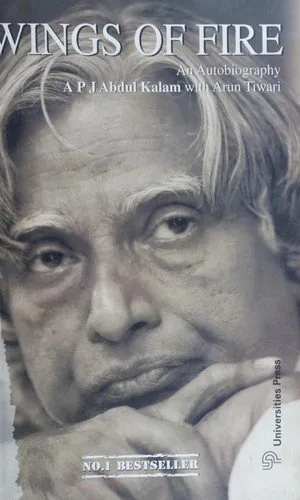
Wings of Fire: An Autobiography, A.P.J. Abdul Kalam with Arun Tiwari (Universities Press, 1999) · A.P.J. Abdul Kalam with Arun Tiwari
Buy on Amazon.in| Authors | A.P.J. Abdul Kalam, with Arun Tiwari |
| Subject | Kalam’s life from Rameswaram in 1931 to the first Agni launch, with an epilogue that reaches 1998 |
| First published | 1999, Universities Press (India), Hyderabad |
| Length | 180 pages plus 16 of front matter, in the Open Library record of the paperback |
| Kind | Autobiography, “as told to”: the subject narrates, a co-author records and writes |
| Sequel | Turning Points: A Journey Through Challenges, HarperCollins, 2012 |
Kalam was born in Rameswaram on 15 October 1931 and was President of India from 2002 to 2007. He died on 27 July 2015 in Shillong. The book was published three years before his presidency, so it is the story of a scientist, not a head of state.
How did Arun Tiwari get access to Kalam?
Arun Tiwari got access from inside the laboratory: he worked under Kalam at the Defence Research and Development Laboratory in Hyderabad for over a decade before the book. Kalam’s introduction says Tiwari had been in his laboratory since 1982.
The two men grew close in February 1987. Kalam visited Tiwari, then 32, in the coronary care unit of the Nizam’s Institute of Medical Sciences. Tiwari asked for his blessing so that he might live to finish at least one of Kalam’s projects. He recovered, and worked on the Akash missile airframe.
The book itself began with a question. In his preface, Tiwari says he first asked Kalam if he had a message for young Indians. Later he asked for the recollections themselves, so he could write them down before they were lost. Kalam turned sixty on 15 October 1991 and had planned to give his retirement to social service. He stayed on in government instead, and Tiwari asked for his story.
Tiwari is plain about his position. He writes that working under Kalam “might seem to disqualify me as his biographer”, and that he had no idea of becoming one. That is access of the closest kind. The subject trusted the writer long before there was a book.
Free printable: Before the handover
39 questions to record with a founder, in eight sessions, so the next generation inherits why the rules exist. Leave your email and download it straight away.
How does the book handle Kalam’s voice?
The book is written entirely in Kalam’s first person, and Tiwari’s own voice stays in the preface. The first chapter opens on the house in Rameswaram, his father Jainulabdeen and the mosque on their street, in the “I” of a man looking back.
The method is in both men’s front matter. Tiwari describes “a long series of sittings late into the night” and before dawn, stolen from Kalam’s working day of eighteen hours. Kalam’s introduction says that over the last year Tiwari “patiently transcribed the bits and pieces of my story and converted them into a fluent narrative.”
That sentence is the whole craft of an “as told to” book. Bits and pieces go in. A fluent narrative comes out. Nothing in between should show.
Tiwari also went through Kalam’s personal library and chose pieces of poetry he had marked over the years. The poems sit through the book beside the prose. It is a writer using the subject’s own reading as part of his voice.
Tiwari admits the difficulty. Kalam’s talk, he writes, “was not always easy to follow, but was always fresh and stimulating”, full of subplots and metaphors, and only slowly did it become one continuous account. Every ghostwriter knows that stage. I wrote about how often it happens in famous books in who really writes famous autobiographies.
From the desk
On my page about whether a book will sound like you, I put the job in two lines: “After enough hours I can write a line you would swear you said.” And: “I want you to forget I was in the room.”
That is the job Tiwari describes in his preface, from the other side of the same desk.
How is the life structured?
The life is structured in four parts, each with its dates in the contents: Orientation (1931 to 1963), Creation (1963 to 1980), Propitiation (1981 to 1991) and Contemplation (1991 onwards), followed by an epilogue.
| Part | Years | What it covers |
|---|---|---|
| I. Orientation | 1931 to 1963 | Rameswaram, school, college, the first jobs |
| II. Creation | 1963 to 1980 | The space programme years |
| III. Propitiation | 1981 to 1991 | The missile laboratory in Hyderabad |
| IV. Contemplation | 1991 onwards | Reflection, and the close of the story |
The part names carry an argument. A life moves from being shaped, to making things, to answering for them, to thinking about what it all meant. It is a clean answer to the hardest structural question in any autobiography: where to break a long working life. I wrote more on that choice in how to structure an autobiography.
The ending holds the book together. Near the close, Kalam names the people who made him: the son of Jainulabdeen of Mosque Street, “a lad who sold newspapers to help his brother”, a pupil of his teacher Sivasubramania Iyer. The last pages call back the first chapters, so the scientist ends where the boy began.
What did the book choose to leave out?
The book chooses to stop at a working peak, the first Agni launch, and says so. “This is the story of the period ending with the first Agni launch,” Kalam writes near the end. Tiwari’s preface calls the book “only a thumbnail sketch” and says many incidents Kalam narrated could not be included.
That is a deliberate frame, and it shows a clear way to draw one. Tell the reader where the story stops, and why.
Kalam also tells us what he nearly left out. His introduction says he doubted that the jobs he did to pay school fees, or why he became a vegetarian in college, could interest anyone. He kept them, he says, because a single life tells “something of the story of modern India”. The small details he doubted are the ones readers remember.
The years after, including the presidency, waited for another book. Turning Points, published by HarperCollins in 2012, is catalogued as the sequel to Wings of Fire. I wrote about choosing the frame for your own book in what to leave out of your autobiography.
What a family can take from it
A family can take four working lessons from Wings of Fire for its own “as told to” book.
- The right writer may already know the subject. Tiwari had nine years beside Kalam before he asked. Trust earned over time shortens every interview.
- Talk first, write later. The book began as late-night sittings. A year of turning them into prose came after. Your parent or founder only has to talk.
- Keep the small details the subject doubts. Kalam nearly cut the school-fee jobs. Those are what make a life recognisable to a grandchild.
- Draw the frame in plain sight. Stop at a point that means something, say so in the book, and leave the rest for a second one. A founder’s story written at a milestone works the same way.
Questions people ask
Who wrote Wings of Fire?
A.P.J. Abdul Kalam and Arun Tiwari. Kalam narrated his recollections and Tiwari, who worked under him at DRDL in Hyderabad, recorded them and wrote the book in Kalam’s first person. Both names are on the cover.
When was Wings of Fire published?
In 1999, by Universities Press (India) in Hyderabad. The book has been reprinted many times since; its co-author’s publisher biography says it has sold over a million copies in eighteen languages.
Is Wings of Fire an autobiography or a biography?
An autobiography: it is told in Kalam’s own voice and reflects his own choices about his life. Because a co-author wrote it from Kalam’s narration, it is often described as an “as told to” autobiography.
What period of Kalam’s life does Wings of Fire cover?
From his childhood in Rameswaram in 1931 to the first Agni missile launch, with an epilogue that touches the nuclear tests of May 1998. His presidency (2002 to 2007) is not in it.
Is there a sequel to Wings of Fire?
Yes. Turning Points: A Journey Through Challenges was published by HarperCollins in 2012 and continues his story.
If you want to hear what a parent or founder sounds like on a page before you commit to a book, A Page in Your Voice is one page from a five-minute recording.
Leave a Reply