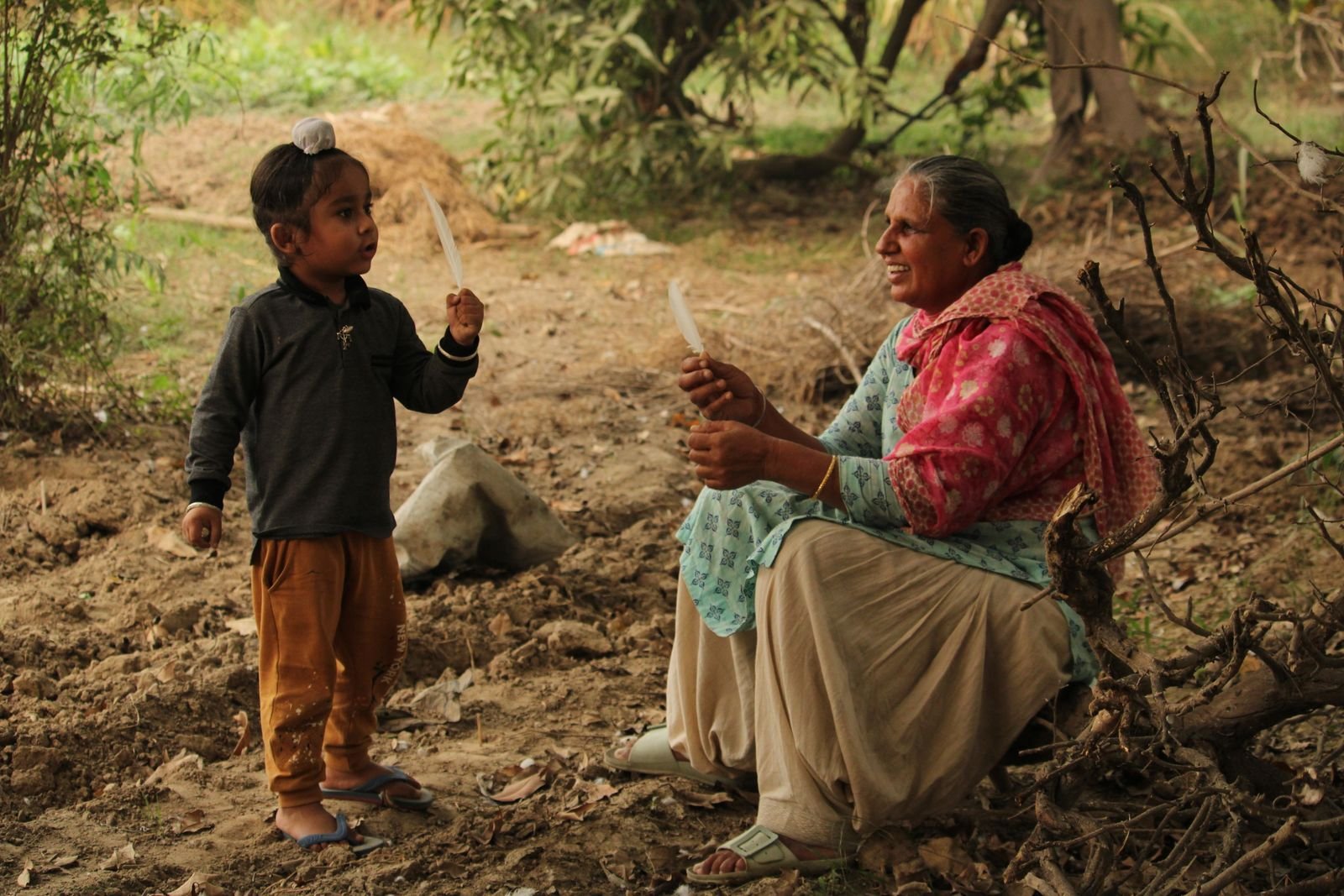
The best questions to ask your grandparents are about places, people and single days: the village and how to spell it, the names in the oldest photograph, the morning they left, the first wage. Ask them in eight short sessions, in the morning, in the language the memory lives in. Sixty questions follow, in that order.
My 100 questions to ask your parents are for a son or daughter. This list is for a grandchild, and none of the sixty repeats them.
How are questions for a grandparent different from questions for a parent?
A grandparent is the last person who can name the generation before them, so the questions reach further back and ask for names, places and spellings.
Three things change when the grandchild asks.
- The reach. Your grandmother knew her own grandparents. Ask her about them and the book covers five generations from one chair.
- The register. On my grandparents’ life story page I wrote that grandparents explain things to grandchildren that they would never bother explaining to me. You are allowed to ask what a ration card was. Ask it.
- The memory. On my grandparents page I wrote that long-term memory outlasts short-term memory by years in most people. A grandmother who can’t remember lunch can describe a wedding in 1961 down to the colour of the sari. So ask about 1961.
The asking does something for the grandchild too. Marshall Duke and Robyn Fivush at Emory University built a 20-question “Do You Know” scale of family stories, and two of its questions are where your grandparents grew up and where they met. Children who know more of these stories show higher self-esteem and fewer behaviour problems, Fivush wrote in Psychology Today in 2016. Her point was that the telling matters, not the score.
How should a grandchild ask the questions?
Short sessions, in the morning, one topic each, with the recorder on and something on the table to hold.
| Do this | Why |
|---|---|
| Book 60 to 90 minutes, in the morning | Many people in their eighties are freshest then. Stop early if they tire |
| Tell them the topic a few days ahead, never the list | “On Sunday, your village” gives them days of remembering. A list gives them an exam |
| Put one object on the table | A passport, a ration card, a wedding card, a photograph with writing on the back |
| Ask in their language | If the village lives in Punjabi or Sindhi, ask there. Translate later |
| Repeat a question a week later | Repetition brings back detail, and it does not bore them |
| Record every minute | The phone is enough. My guide to recording your parents’ life story on a phone has the settings |
| Ask permission before the hard years | Partition, a death, a lost house. Never push |
Eight sessions of seven or eight questions each. You will not get through all of them in one sitting, and you shouldn’t try. Follow the answer, then come back to the list.
Free printable: 100 questions to ask your parents
Ten sessions, ten questions each, in the order that gets a parent talking. Print it, take it home, tick them off as you go. Leave your email and download it straight away.
The 60 questions to ask your grandparents
Eight sessions, easiest first: the place, the people, their youth, the move, the work, the marriage, your parent, and the food and songs.
Session one. The village, and how to spell it
Start with the place, because a place has no wrong answers.
- What was the name of your village or town, and how do you spell it? Write it for me in your own script too.
- Which district was it in, and which is the nearest big town?
- Walk me from the bus stop or the railway station to your front door. What do I pass?
- What was the house built from? Which room was yours?
- Where did the water come from, and who fetched it?
- Which tree, well, temple, gurdwara, mosque or shop do you remember best, and why?
- If I went there today, what would I look for?
Session two. The people before you
This is the session with a clock on it. Do it early.
- What were your grandparents’ full names? What did you call them?
- What do you remember about your grandmother’s hands, her voice, her cooking?
- What work did your grandfather do, and where?
- Who is the oldest person in the family you ever met? What did they tell you?
- Which surname, gotra or clan name did the family use, and did it change?
- Is there a family story about where we came from, before that village?
- Let’s take the oldest photograph we have. Who is everyone in it, from left to right?
Session three. When you were my age
Grandchildren get answers parents don’t, so use the comparison.
- What were you doing at my age? Where were you living?
- What did you want to become, when you were my age?
- Who was your closest friend? What happened to them?
- How did you get to school, and what did you carry?
- What did a film, a radio programme or a bus ride cost then?
- What was the first thing you ever bought with your own money?
- What did your parents forbid that you did anyway?
Session four. The crossing, the move, the leaving
Ask before you start: “Is it all right if we talk about the year you moved?” If the answer is no, skip to session five and don’t come back unless they do.
- When did the family first leave the place it had always lived?
- Who decided? Who argued against it?
- What did you carry, and what did you have to leave?
- Where did you sleep the first night in the new place?
- Who helped you when you arrived? Do we still know that family?
- Was there anything you were never able to go back for?
- What did you tell your children about it, and what didn’t you tell them?
For many families in Punjab, Sindh and Bengal, this session is 1947. For others it is a train to Bombay, a ship to Mombasa or a flight to Dubai. On my grandparents page I put it in two words: never push. That silence has held for decades, and it is theirs.
Session five. Work and the first money
Every working life has a first job, and if there was a business, the version on the company website is not the one your grandfather tells.
- What was your first job, and what did it pay?
- Who taught you the work?
- If there was a shop or business, who lent the first money?
- What was the worst year for money? How did the house manage?
- What did a good day at work look like?
- What job do you think you’d have been good at, if things had gone another way?
- What did you teach my parent about money?
Session six. Marriage, the house and the women in it
Ask each grandparent alone. Together, one tells and the other corrects.
- How was your marriage arranged? Who came to see whom?
- What do you remember of the wedding day, from the morning?
- What was your first home together like? Who else lived there?
- Who ran the household, and how?
- Nani, Dadi: what did you want to study, or do, before you married?
- What did your mother-in-law teach you? What did you decide to do your own way?
- Who in the family worked hardest, without anyone noticing?
- What did you two argue about in the first year?
Session seven. My parent, when they were small
This is the chapter only they can tell you.
- What was my father or mother like as a baby?
- What did they get into trouble for?
- What were they afraid of?
- What did they want to be?
- What did they do that made you proudest?
- What were you most worried about, when they were growing up?
- What do I do that reminds you of them, or of you?
Session eight. Food, songs, words, and looking back
This is the layer nobody writes down.
- What was cooked on which day of the week, and why?
- Which dish do you make that nobody else makes the same way? Show me while I record.
- Sing me a song your mother sang. Where did she sing it?
- Which words or sayings did your family use that I have never heard?
- Which festival was the biggest in your village? What happened that day?
- What changed in your lifetime that you still can’t believe?
- What do you know now that you wish someone had told you at twenty?
- Which year of your life would you live again?
- What should every grandchild in this family know about us?
- Is there anything I haven’t asked that you’d like to tell me?
What should you do with the answers?
Copy the recording the same day, then write the best story from each session in one line with the time it starts.
- Keep three copies. The phone, a laptop and a shared cloud folder the family can see. Name each file with the date first.
- Log, don’t type everything. A list of times and topics is enough for now: “14:20, the train to Amritsar.”
- Check names and spellings with them while they are here to correct you. Spellings drift.
- Label the photographs you talked about, on the back, in pencil, with names and the year.
- If they crossed in 1947, the 1947 Partition Archive has preserved over 12,000 memories of Partition witnesses. It trains volunteers as Citizen Historians in a free two-hour workshop, so a grandchild can learn its method before recording.
If you want the rest of the method, from consent note to printed hardback, it is in how to write your parents’ life story, and it works the same way for a grandparent. If you live abroad, interviewing family from another country covers the time zones and the calls. If you want ten questions picked for you, try the life story question generator.
From the desk
On my grandparents’ life story page I wrote that a family loses its own history in about sixty years. The person who remembers dies, the person who half-remembers moves country, and the grandchild inherits a surname and a vague region.
The fix is not a book, at first. It is a recording, and a grandchild with a phone can make it this month. I also wrote there that some sessions don’t work and some days are bad days, and that the sentence which arrives in the fourth hour of a slow week is the one the book turns on. So record the slow weeks too.
For the record, my gift book is ten or twelve of those stories, written by me, from US$5,000 and typically up to US$10,000. Any travel to sit with your grandparent is paid by you, at cost.
Questions people ask
What are good questions to ask your grandparents?
Questions about one place, one person or one day. “What was the name of your village, and how do you spell it?” and “Who is everyone in this photograph?” get more than “What was life like back then?” Ask about the people before them early, because they may be the last who can name them.
How do you get grandparents to talk about their past?
Put an object on the table, ask about it in their language, and stay quiet after the answer. A passport, a ration card or a wedding card does more prompting than any list. Short morning sessions work better than one long afternoon.
Should I ask my grandparents about Partition?
Ask whether they are willing first, and accept a no. Many people who crossed in 1947 never told their children in detail. Some talk about the years around it and come to the event itself on their own. If they never do, that silence belongs in the record too.
What if my grandparent has memory loss?
Ask about the distant past and use photographs and objects. Long-term memory holds longer than short-term memory in most people. Keep sessions short, follow their lead, and record everything, because some days will work and some won’t.
If you’d like to hear one of their stories written as a page before deciding anything else, A Page in Your Voice takes a five-minute recording and returns one page in their voice within a week, for US$1,000, credited against a book.
Leave a Reply